
Quarterly highlights – Q4 2025
January 15, 2026
Developing my skills and building a better future for my family
February 25, 2026Being heard, without a sound
MEET IBRAHIM

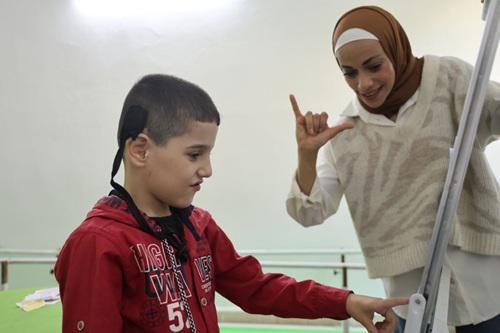
Dounia is a speech therapist at one of our partner child friendly spaces in Syria, which welcome children with disabilities. In her dedication, she recently learned sign language to be able to serve children with hearing impairment. She shared with us the story of Ibrahim, a young boy who cannot hear:
“Ibrahim is a child who suffered from oxygen deprivation at birth, which led to severe damage to the cochlear nerve responsible for transmitting sounds from the outer ear to the brain, resulting in severe hearing loss. Although Ibrahim had a cochlear implant in 2021, he was still unable to hear when he joined the child friendly space in 2024. We started speech therapy sessions with him, making repeated attempts to produce letters and words, but all attempts failed. Ibrahim remained unable to hear sounds. Because of his inability to communicate or express his needs, he attended the center with extreme shyness, observing more than participating, and feeling isolated despite being among other children.
This is when we decided to teach him sign language instead. This was something new at the center, as this service had not been provided before. Learning sign language requires different educational tools such as showing some videos, using printed materials, and having other children present so the child could imitate them, using the available resources at the center. Our initial work with Ibrahim focused on learning the alphabet in sign language so that he could form words and begin using letters while expressing himself. The child was also taught how to introduce himself and the names of family members in sign language. From the beginning, we believed that language is not built only during sessions but is planted at home and grows in daily life.
Therefore, during the sessions, the presence of the mother – who is closest to the child – played a very important role. The goal was to teach the mother sign language too so she could communicate well with the child, teach sign language to her other children and the father at home, follow up on the training carried out at the center, and turn every daily situation into a learning opportunity.

Ibrahim is a very sensitive child. He becomes upset when he tries hard to express what he wants but cannot get his voice across to others. Therefore, we began working on teaching categories and the names of objects around him so he could know their correct names and express his needs in a way that allows him to “be heard” even without producing sounds. We worked on teaching him – and his mother – the names of fruits, vegetables, colors, everyday objects.
After a while, he slowly became able to communicate with his family and his environment in general, and we noticed a beautiful change in his behavior and personality. In one session, he pointed to indicate that he wanted the green and red balls to play with. When I brought them to him, he realized that he had expressed himself correctly and that someone understood him. He felt great happiness, as if he was going to explode from joy.
Because language is not limited to words, we dedicated an important part of the training to teaching him emotions in sign language too, such as happiness, sadness, anger, and fear. This training enabled the child to express his emotional state instead of crying or withdrawing, and he became able to communicate what he feels clearly and confidently without fear. He was also taught numbers so he could use them in daily life.


